In a region where agriculture is a cornerstone for food security and a direct source of livelihood, agricultural viability is declining amid a climate crisis that the Middle East and North Africa bear disproportionately on a global scale. Temperatures are rising at nearly twice the global rate, while severe and increasing water scarcity has placed the region among the driest in the world, putting agricultural security, and, by extension, food security and the future of communities on the brink.
The climate crisis disproportionately affects local communities in our region, which are often among the least responsible for global greenhouse gas emissions, yet bear the heaviest burden of its impacts. In this context, farmers and rural households are experiencing declining agricultural productivity, losses in livestock, and growing economic pressures, directly undermining the stability and sustainability of their livelihoods.
The challenges go beyond environmental and climatic factors. They intersect with deep structural pressures: from rapid population growth to neoliberal economic policies that entrench unequal growth models, exploit natural resources, and accumulate profits at the expense of the environment and local communities’ rights. Added to this are armed conflicts, political instability, and social and economic crises across several countries in the region, further weakening agricultural systems and their capacity to withstand and adapt.
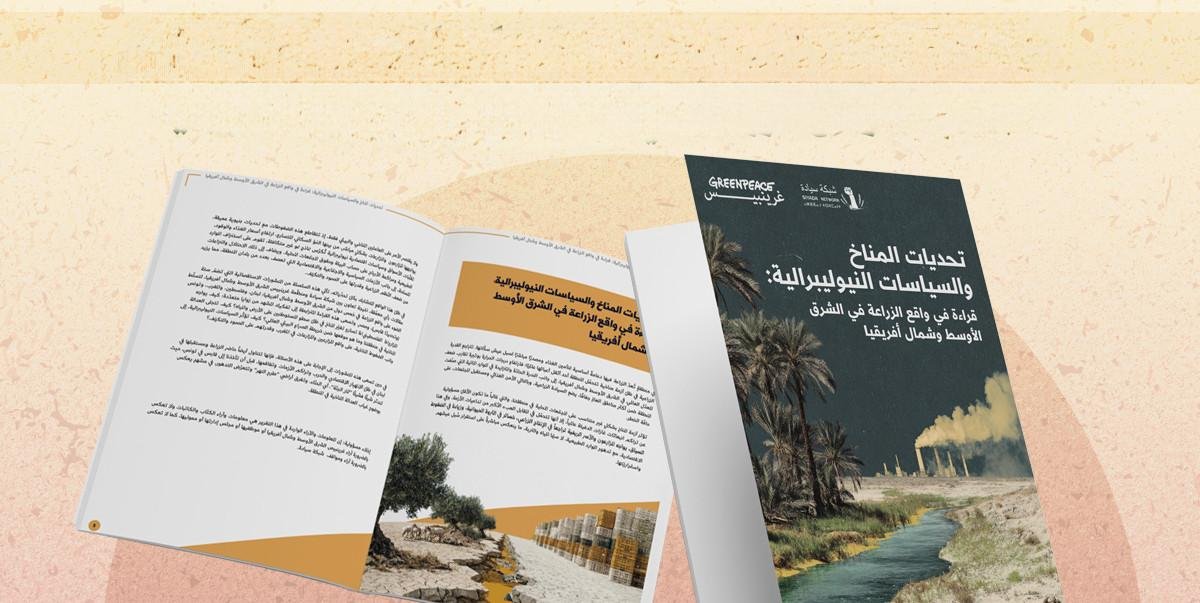
Amidst this complex reality with all its challenges, this series of investigative publications—comprising six in-depth opinion pieces—has been produced through a collaboration between Siyada Network and Greenpeace MENA. The series sheds light on the state of agriculture in five countries across the Middle East and North Africa: Lebanon, Palestine, Morocco, Tunisia (specifically Gabès), and Egypt. This interconnected reading seeks to unpack the landscape from multiple perspectives: How do the Palestinian farmers face accelerating climate change amid settler encroachment on land and water? How does climate justice manifest in our region, and where does it fit within the global environmental conflict map? Most importantly, how do neoliberal policies, alongside climate pressures, affect Moroccan farmers’ capacity to survive and adapt? While these publications seek to answer these questions, they also examine the present and future of agriculture in Lebanon amid economic collapse, war, and accumulating crises. They then take us to Gabès in Tunisia, where the “fruits of paradise”—the henna—are gradually disappearing, and the lands of the river plain are being flooded and degraded, presenting a striking illustration of the absence of climate justice in the region.
- To read the full Study in Arabic: click here